



Marriott captures the enchantment and genius of Sondheim in A Little Night Music
It is cliché at this point to say that Stephen Sondheim was a genius. But as the first notes of the overture to A Little Night Music drifted through the Marriott Theatre on opening night, that was the only thought I could summon. And as the evening unfolded, it returned again and again. The songs do exactly what songs in a great musical are meant to do: they emerge so naturally from the dialogue that you never question why the characters begin to sing. Instead, you think, of course this moment could only be expressed through music. Sondheim’s score is dazzlingly intricate, both musically and lyrically. Each song feels like an exquisitely layered dessert, rich enough to savor, yet somehow leaving you eager for the next bite. Your ears never quite settle. They are constantly delighted, surprised, and rewarded as each number propels the story effortlessly forward. For example, after the Greek Chorus opens the show in the overture, we meet Fredrik (Andrew Samonsky) in his song, “Now”, his son Henrik (Eldon Warner-Soriano) through “Later,” and Fredrik’s young wife Anne (Addie Morales) in “Soon,” before they are all woven together in a beautiful trio that ends with Fredrik muttering the name of actress and old love, Desiree (Alexandra Silber).
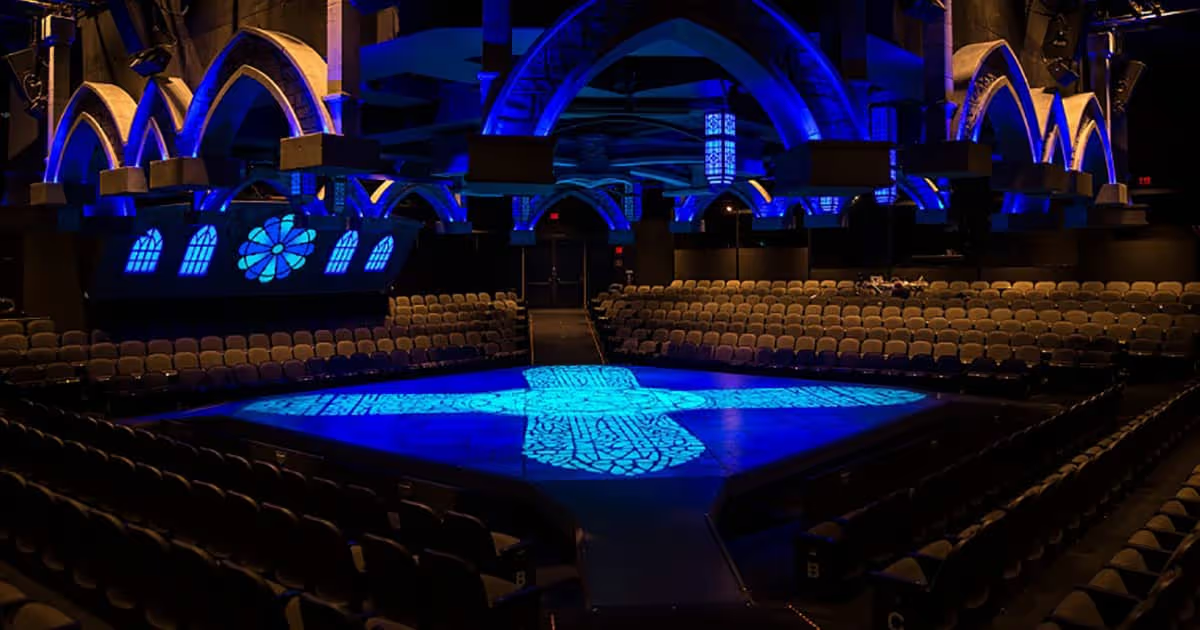
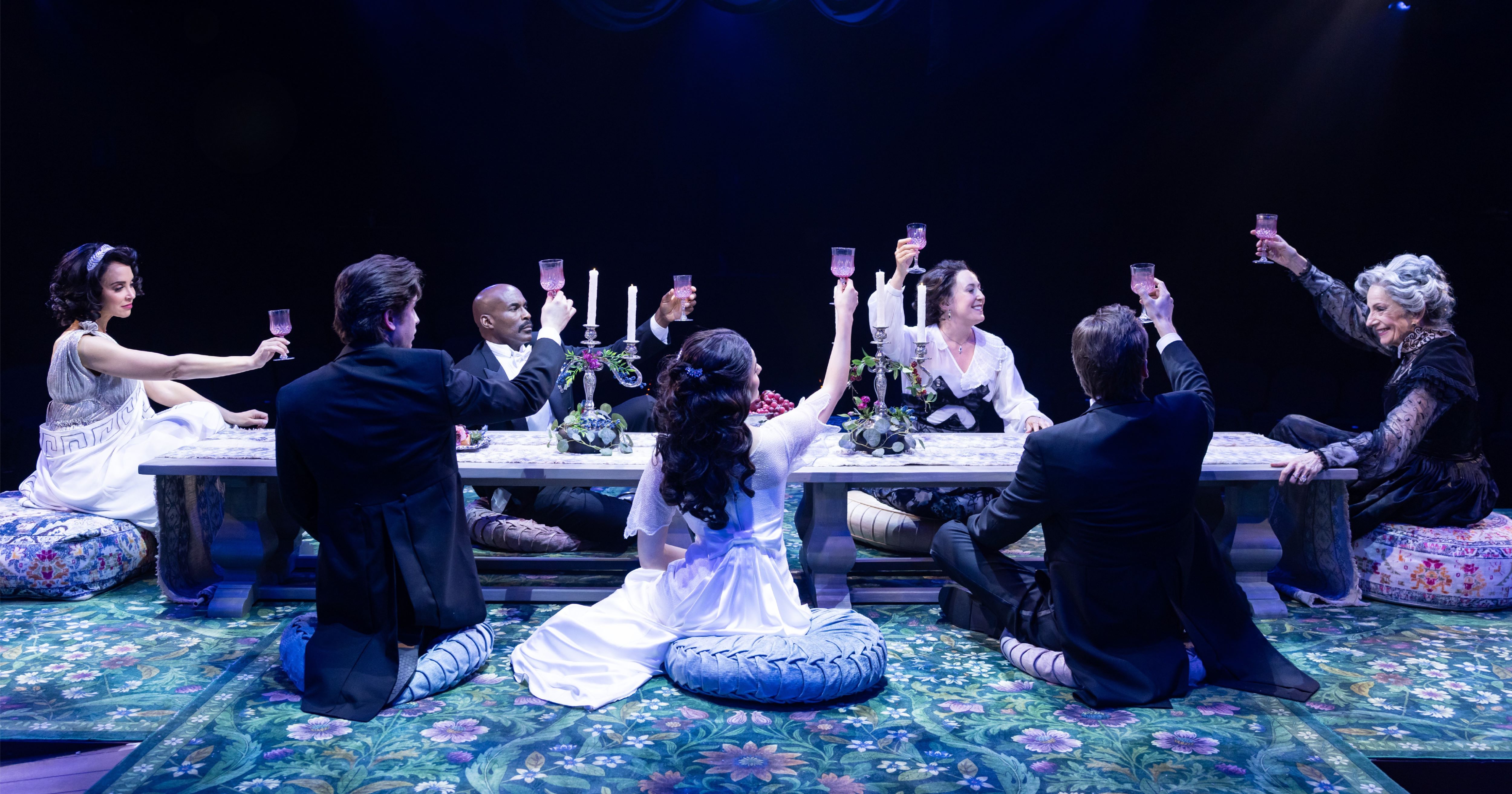
A Little Night Music, like all Sondheim musicals is not only musically complicated and fulfilling but the libretto is equally satisfying. The 1973 musical is based on the Ingmar Bergman movie, Smiles of a Summer Night. Unlike many of Sondheim’s shows, however, A Little Night Music is predominantly a comedy with much drama woven in. Director Nick Bowling takes this 1973 show, based on the 1955 film and set in the early 1900’s and with a highly talented cast, stages it in a way that keeps the audience engaged, laughing and rooting for love throughout. Using Marriott’s theater in the round, Bowling makes us feel like we are all invited guests to the intimate moments of this tangled web of lovers. Particularly satisfying is scenic designer Regina Garcia’s Act II setting of Madam Armfeldt’s (Carmen Roman) country home. How smoothly the actors shift the benches around the stage to create the feel of many different spaces, culminating in one of the funniest scenes I’ve ever seen- a picnic dinner where the entangled lovers intersect. Equally satisfying are Jesse Klug’s cool, soft lighting choices, which bathe the stage in an almost dreamlike glow. And Sally Dolembo’s sumptuous period costumes complete the illusion, every gown, suit and military uniform reflecting both the characters’ personalities and the quiet sophistication of the world they inhabit.
A Little Night Music focuses on Fredrik, his son Henrik and his second and much younger wife Anne, who even after 11 months of marriage is still a scared and shy virgin. As a treat, Fredrick takes Anne to see a play starring Desiree Armfeldt, whom we discover is a former lover of Fredrik. Of course, in the 14 years since their affair, Desiree has had a number of other lovers, including current flame, Carl-Magnus Malcolm (Alan H. Green). After Desiree and Fredrik briefly rekindle their feelings, Carl-Magnus becomes suspicious and brings his concerns to a very salty but patient wife, Charlotte (Veronica Garza). Desiree comes up with a plan to try to win Fredrik back by inviting him and his family to her mother’s country home, where her daughter, Fredrika (Olivia Grace O’Sullivan) lives with her grandmother. Not only do Fredrik, Henrik and Anne arrive, but so do Charlotte and Carl-Magnus and of course, chaos ensues.
While the story and music alone would bring me back to this show again, the cast of the Marriott is truly extraordinary. There is not a weak link and everyone is perfectly cast for their role.
Morales is the evening’s first revelation. Her luminous soprano perfectly captures Anne’s innocence and youthful optimism while never reducing her to naivete alone. She creates a young bride full of hope and uncertainty, providing a beautiful contrast to both Samonsky’s worldly Fredrik and Silber’s confident, sophisticated Desiree.
Samonsky gives us a Fredrik who genuinely loves and respects his young wife while quietly realizing that love alone may not be enough. His rich baritone and understated performance perfectly suit a man caught between youthful passion and mature companionship. Like the entire cast, he is vocally strong and convincingly worthy of both the beautiful and complicated Sondheim lyrics.
Warner-Soriano as Henrik is naive in his own way, on break from seminary and torn between the rigid morality he has devoted his life to and desires he cannot suppress. His haunting cello solo while singing “Later,” provides great character development.
Green relishes every moment as the pompous, delightfully oblivious Carl-Magnus Malcolm. Equal parts swagger and insecurity, he storms through each scene convinced he is the cleverest man in the room while missing nearly everything happening around him.
In this show, just about everyone gets a moment to shine: Roman’s Baroness is a witty and observant grandmother while even the maid, Petra (Madison Uphoff), commands the stage with her song “The Miller’s Son.”
With all of this, it is hard to pick a standout in the cast, and I struggle to narrow it down, but Garza’s Charlotte nearly walks away with the show. Beneath her razor-sharp wit lies genuine heartbreak, and Garza balances those competing emotions beautifully. Her timing is impeccable, particularly during the picnic sequence, one of the funniest scenes I have seen in quite some time.
And then there is Silber’s Desiree. She possesses the effortless confidence of a woman who knows exactly how she affects those around her, yet she allows flashes of vulnerability to emerge just when they matter most. Her rendition of “Send in the Clowns” is breathtaking, not because it is oversized or theatrical, but because it feels deeply lived in. It is intimate and heartbreaking and quietly unforgettable.
A Little Night Music surprised me. When reading the synopsis, I wasn’t sure it would be a show that would resonate with me. Yet within minutes, I was completely enchanted. Though set more than a century ago, its observations about love, longing, regret, and second chances feel remarkably timeless. Marriott’s production wraps those themes in extraordinary music, elegant visuals, and performances of exceptional warmth. As soon as the show ended, I wanted to see it again. That is perhaps the highest compliment I can give. Marriott has created something visually stunning, vocally extraordinary, and quietly enchanting, a production that lingers in your mind long after the final waltz has ended.


